One in Five B2B Sellers Will Face Quote Negotiations Led by AI Buyer Agents This Year

With commerce protocols live from Google and OpenAI and venture money pouring into procurement agents, machine-to-machine buying has moved from thought experiment to roadmap.


If this caught your attention, that’s not accidental.

The best editorial systems don’t happen by accident. Outlever builds them.


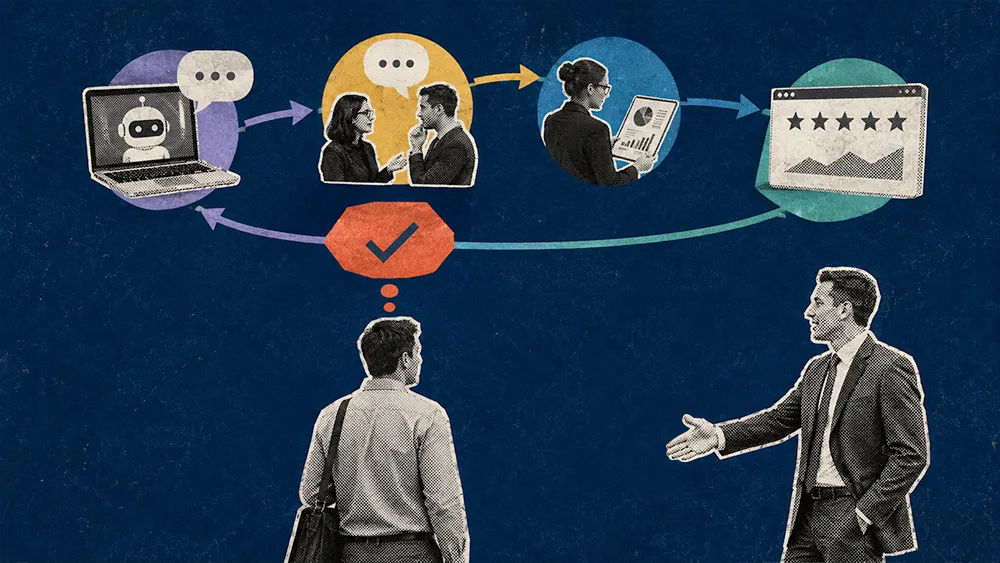
The strangest sales call of 2026 has no one on the other end. In its predictions for the year, Forrester forecasts that one in five B2B sellers will be compelled to respond to AI-powered buyer agents with dynamically delivered counteroffers via seller-controlled agents of their own. The same research finds 61 percent of purchase influencers saying their organization has or will deploy a private generative AI engine to support purchasing. The buyer is not just researching with AI anymore. The buyer is delegating to it.
The infrastructure went live this year
What makes this a 2026 story rather than a 2030 one is that the plumbing has arrived. Google launched its Universal Commerce Protocol at NRF in January, an open standard letting AI agents interact with merchant catalogs and complete purchases, and OpenAI's Agentic Commerce Protocol, built with Stripe, is live with major partners. Gartner projects AI agents will intermediate 15 trillion dollars in B2B purchases by 2028.
The capital is following the protocols. Procurement-agent startup Lio raised a 30 million dollar Series A from Andreessen Horowitz in March to automate the full purchasing lifecycle, part of a reported 9.7 billion dollars invested in agentic AI startups since 2023. When the world's largest platform companies ship the rails and the venture market funds the trains, the prediction stops being speculative.
The buyer's agent plays favorites
The uncomfortable part for sellers is how an AI procurement agent chooses. It favors suppliers whose product data, pricing, and terms are structured and machine-readable, and it effectively cannot see the ones whose answers live in PDFs and discovery calls. The discovery layer is already tilting this way with human buyers: a G2 survey of more than a thousand B2B software buyers found half now start research with an AI chatbot, 69 percent chose a different vendor than they originally planned, and a third bought from a vendor they had never heard of before the AI surfaced it. Shortlists are being rewritten by machines before a seller knows the deal exists.
Accuracy is the battleground inside that shift. The same G2 research found 64 percent of buyers encountering inaccurate AI recommendations often or very often. An agent working from wrong information produces wrong shortlists, and the vendors who win will be the ones who make it trivially easy for both humans and machines to get the truth about their product: verified answers, current pricing logic, real technical documentation, delivered through interfaces an agent can query.
What sellers put on the other side of the wire
You cannot answer a buyer's agent with a brochure and a calendar link. Forrester's prediction contains its own prescription: sellers respond through seller-controlled agents, an autonomous layer that can present the product, field the technical question, produce the quote, and negotiate within guardrails the revenue team defines. That last clause is where the engineering gets serious, because analysts already warn that naive agent-to-agent negotiation tends to converge on the seller's price floor, since software discloses constraints in ways trained humans never would. A seller-side agent without hardened rules is a margin leak with an API.
None of this removes people from the deal. It relocates them. When machines handle the information exchange and the first rounds of structure, the human seller's remaining work is the part that was always the point: the relationship, the political navigation, the judgment call a committee will actually trust. The sellers who staff that layer deliberately will welcome the buyer's agent as the most efficient qualification tool ever built. The ones still routing every inquiry to a form will be negotiating with machines by default, unarmed.





Read what the room is reading.
New pieces for growth leaders, delivered as they publish. Unsubscribe whenever.