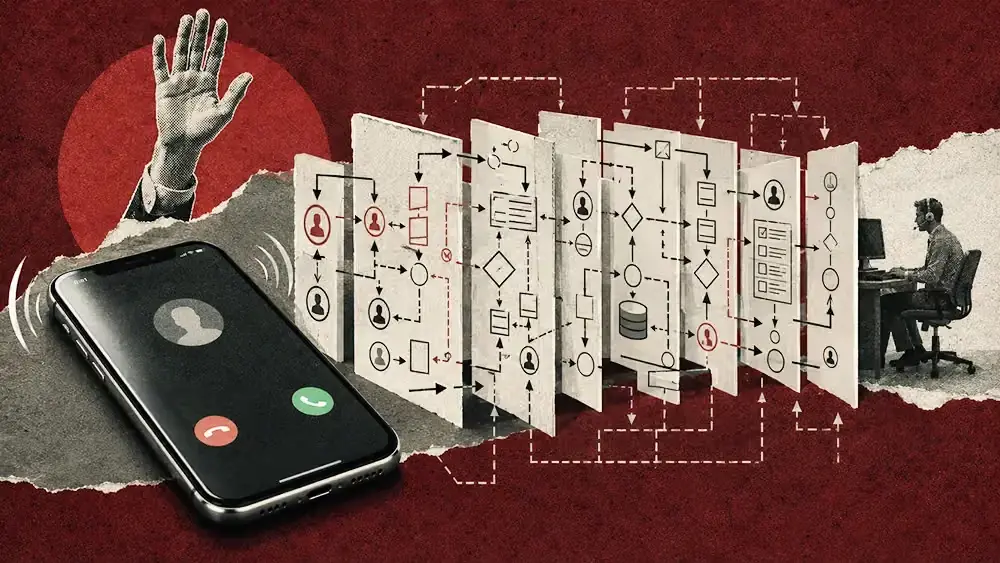
Proof Of Change Creates The Adoption Evidence Clients Ask For After The Demo

Christine Benchemam, Senior Vice President and Client Lead at Monks, explains why a working prototype no longer proves much to a client, and what she measures in the months after a launch instead.

The biggest barrier is the human element and friction. Building the thing is rarely the hard part anymore. Getting people to alter their daily habits is.


If this caught your attention, that’s not accidental.

The best editorial systems don’t happen by accident. Outlever builds them.


Building a campaign prototype has become fast and inexpensive. AI tools compress work that once took weeks of production, so a finished demo no longer separates one agency from another. Clients now ask what changed in the months afterward: whether their teams used the tool, whether the workflow ran faster, and whether the same budget covered more work. Those questions call for different evidence than a completed prototype provides.
Christine Benchemam is Senior Vice President and Client Lead at digital marketing and technology company Monks, where she leads client business in the Canadian market and works with US teams on North American accounts. Much of the AI work she describes runs through Monks Flow, the company's own workflow platform. Before Monks, she was a managing partner at OLIVER, an agency that builds and runs marketing teams inside its clients' own organizations.
"The biggest barrier is the human element and friction. Building the thing is rarely the hard part anymore. Getting people to alter their daily habits is," says Benchemam. A tool that runs correctly in a demonstration proves the build works and settles nothing else, and Benchemam calls that proof of concept. Proof of change is a team still working differently after the project has closed. She can point to it in the client's own cost base and speed to market, and it's the evidence she brings to a client review.
Solving the adoption problem
Benchemam looks for evidence of change in the client's own operations rather than in a delivery report. Each measure she names can be read from reporting the client already runs, and none of them requires new research or a survey of the client's staff. The read is available within weeks of a launch rather than at the end of a contract. "We look beyond technical success," says Benchemam. "We measure adoption rates, workflow velocity, budget efficiencies, and shifted client behavior."
A tool can perform well in a demonstration and leave the client's daily process untouched, because the workflow around it never changed to accommodate it. Benchemam calls that an agency sandbox, where a capability works inside the agency and never reaches the markets a client operates in. She installs the technology inside the systems client teams already use, so the daily process changes rather than the demonstration environment. "We aren't just testing AI and automated tools in a lab," notes Benchemam. "We're embedding them into the enterprise workflows so they transform speed, cost, and output across global client teams."
Benchemam sets the success criteria at the point where a person changes what they do, and she plans for that change at the start of a project rather than after delivery. Projects that begin without an adoption and change plan attached to day one are the ones she describes as failing. "We need to define what success looks like in human behavior, not just software output," explains Benchemam. "Proof of concept is not moving the needle. We have to look down the line and ask whether it's actually going to make a change."
Where AI moves production dollars
Localizing a campaign for a new market has traditionally required a fresh shoot, with a production cost attached and a timeline measured in months. Benchemam works from assets a client already owns instead. The production budget a shoot would have absorbed stays available, and she redirects it toward media and audience targeting in the region running the campaign. What the client gains is a reallocation rather than a smaller invoice. "Instead of spending months and months on a production shoot, we can take the core brief, take existing assets, and create a storyline much faster," says Benchemam.
Agencies that open a project inside an AI platform get back an aggregate of what everyone else has already put into it. Benchemam keeps the human conversation about the audience ahead of the tool in her sequence, so the output arrives as raw material for that conversation. Teams that reverse the order lose contact with the people they are trying to reach. "AI is just an umbrella that feeds everything that everybody is populating into, but it won't actually give you a clear answer," notes Benchemam. "It'll give you some starting point."
Benchemam recruits for judgment about when that output is worth keeping and when to set it aside. She describes running human thinking through an AI platform to check whether a direction holds against the research already loaded into it, an exercise closer to consulting a sounding board than requesting an answer. The teams she wants can work at the platform's speed without deferring to it. Agencies that decline the tools entirely lose time to competitors already using them for workflow, scaling, and automation. "The skills from legacy times are still needed, but your thought process needs to open up to be able to leverage AI for insights and data and localization," adds Benchemam.
Transcreation over translation
Canadian priorities differ from American ones, and so does the phrasing that carries them. Benchemam meets that gap whenever a US team lifts an asset north and expects it to land unchanged. Translating again into French for Quebec adds a second layer, where tone and meaning move again. Her check is a persona built from the client's business challenge and sent to teams across the Canadian market, who report whether it describes anyone they recognize before any spend follows. "We need transcreation and not translation," says Benchemam. "We can't just translate word for word what you're saying in English in the US, because Canadians just don't talk like that."
Benchemam also reads what audiences write about a brand where the brand has no say in the wording, because Reddit threads and large language model outputs carry commentary that reaches consumers before an agency sees it. The unfavorable comments give her the exact language an audience uses about a client, and she works from that language when she adjusts a message. "Sometimes it's good to know what brutally honest commentary is being stated about our agency or our brand," she notes.
Benchemam uses the same sequence on a campaign that she uses on a deployment. A habit is already in place before the work starts, and changing it is the whole task. Cultural moments are where she looks to see whether a brand has reached an audience at all. "Changing the experience will change the behavior, but you have to start with the experience first and show up where your target audiences are," concludes Benchemam.





Read what the room is reading.
New pieces for growth leaders, delivered as they publish. Unsubscribe whenever.