Purpose-Built Sub-Agents Hold Accuracy And Speed On Live Sales Calls

Sachin Bhat, Co-Founder and CTO at 1mind, explains how splitting an agent into single-job sub-agents keeps it accurate on live sales calls as its range of tasks grows.

Every action needs to be validated before it's executed. All of this needs to happen under very strict latency response budgets, especially in voice, where it should be at the speed of a human conversation, not of an awkward silence.


If this caught your attention, that’s not accidental.

The best editorial systems don’t happen by accident. Outlever builds them.


AI agents have started joining live B2B sales calls as named participants, answering technical questions alongside a human seller. The EU AI Act's transparency rules now require companies to tell people when they are speaking with an AI system, a requirement reaching agents that sit in on sales calls. The buyer and the seller both judge the agent on what it answers and how quickly, which greatly depends on how the agent was built in the first place.
Sachin Bhat is co-founder and CTO at 1mind, whose agents work across a company's website, its product, its live sales calls, and its customer support. Scribe, the company he founded in 2017, ran top-of-funnel sales work on a mix of AI and human reviewers. Bhat then led engineering for Rippling product lines earning more than $100 million a year and ran the firm's data and AI infrastructure. He treats the live sales call as the most challenging place for an agent to work.
"Every action needs to be validated before it's executed. All of this needs to happen under very strict latency response budgets, especially in voice, where it should be at the speed of a human conversation, not of an awkward silence," says Bhat. He treats the latency limit in voice as the constraint that makes everything else harder. An agent sitting in a sixty-minute call works under it continuously, following who is speaking, judging whether to answer, and bringing up the right material. Every one of those judgments happens while the conversation keeps moving, and there's room for each one to go wrong.
Accuracy as architecture
A prompt tells an agent what to say. Whether the agent gets it right every time depends on the software built around that prompt. On a published benchmark that has AI agents handle retail and airline customer service tasks, the best performers got fewer than half right on a first attempt. Across eight runs of the same retail task, fewer than a quarter came out right every time. Bhat's agents face the same problem in front of paying customers. "You can't just trust a bunch of prompts," Bhat notes.
1mind's agents run for many customers at once, selling different products and doing different jobs. When an agent gets something wrong in a live meeting, the buyer and the seller both watch it happen. The account executive is the one who has to carry on afterward. "We have to make sure that across all our customers the same level of accuracy, latency, and capabilities are portable," explains Bhat. "Works every single time for every single meeting."
Splitting decision from execution
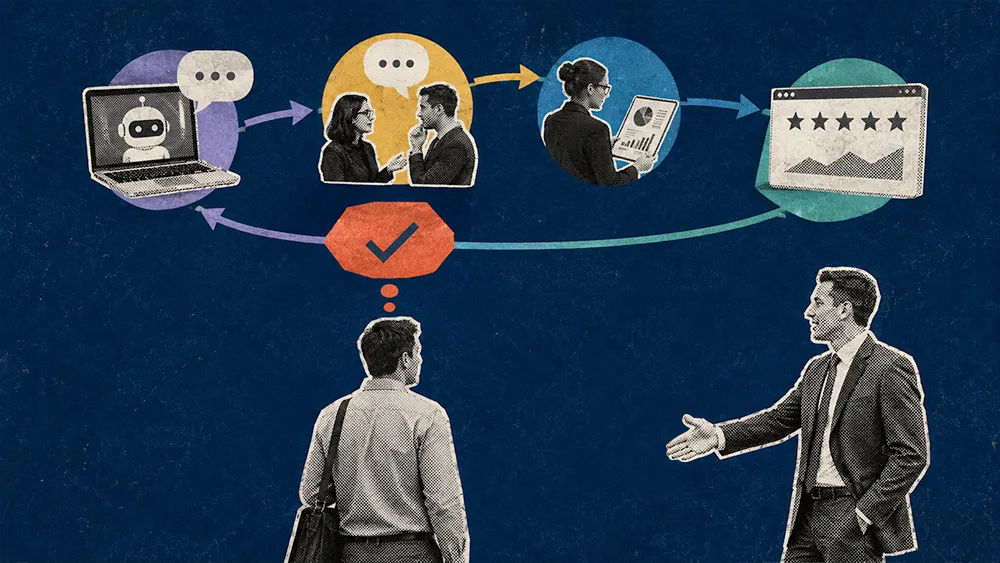
The way Bhat's team builds agents is what holds breadth, accuracy, and speed together. Each thing an agent can do becomes its own sub-agent with a single defined job. Every job ends on a different surface: a CRM record, an outgoing email, a slide, or the product console the agent operates during a live demo. The same capabilities stay available whichever job the agent is doing, and the sub-agent that owns a surface is the one that handles the action there. "The decision making agent and the actual decision execution are being separated," says Bhat. "Decision execution is a sub agent, decision maker is the manager."
Each sub-agent can carry its own evaluation runs, simulations, and validation checks. Bhat's team controls the performance of every sub-agent across all customers at the same time. Each customer also gets its own configuration setting how that account wants the agent used. "We didn't go with a single agent for a single use case," Bhat explains. "It's a swarm of agents that coordinate together to pull off a particular use case."
Above the sub-agents is one agent Bhat calls the "manager," and it handles the conversation itself. The manager tracks what the buyer wants, what the agent has already shown them, and what should happen next. A model with more material in front of it is likelier to give a wrong answer, and Bhat designed the manager around that. "The context is maintained by one agent," notes Bhat. "It only passes what is absolutely needed to the sub agents."
Inside the live call
Before a sales call starts, a company can load an agent with relevant information, including notes from earlier meetings. Everything else arrives during the call, including how the account executive handles a technical objection and what has already been covered. Both change what the agent should do next. "A lot of the sales context is in real time," Bhat says. "It's live in the moment. You might get all the context pre-meeting and add it to the agent. But what happens in the meeting is the sell."
The account executive is part of what the agent has to track, judging how well the human seller is handling a question before deciding whether to speak. A seller who explains the product clearly needs the agent to answer only what it's directly asked. "In the meeting, if the account executive is finding it tough to explain the technical aspects, the agent should take the floor much more strongly and explain the technical terms better," adds Bhat.
When agents take the floor in Europe, the buyer already knows they're AI and Bhat welcomes the rule. Companies have been uneasy about putting voice AI in front of customers, and plain disclosure makes adoption easier. His team switches a disclosure notice on by default for European calls, in the chat window and spoken aloud. Customers running agents elsewhere can turn it on, too. "If we can actually be explicit to the end customer that you're speaking to an AI, and the end users are happy to talk with the AI, that's a strong indication that the market wants to talk with an AI," Bhat concludes.





Read what the room is reading.
New pieces for growth leaders, delivered as they publish. Unsubscribe whenever.