AI-Heavy Revenue Orgs Are Running a Third Leaner at the Same Revenue

The AI-forward revenue orgs in ICONIQ's 2026 GTM benchmarks beat their peers on quota attainment by a margin small enough to dismiss, and the dismissal misses the real break sitting in the same data.

If this caught your attention, that’s not accidental.

The best editorial systems don’t happen by accident. Outlever builds them.


The companies running AI deepest in their revenue orgs are beating their peers on the exact number a Chief Revenue Officer carries into a board review, and the gap is small enough to wave off. Reading ICONIQ's 2026 State of Go-to-Market survey of more than 150 B2B software GTM leaders, SaaStr laid the split out in one line. Where AI is fully embedded in the revenue org, 67% of ramped Account Executives hit quota. Where it isn't, 59% do. Eight points. Set that against the way every efficiency number gets read and the reflex is to shrug, a few more reps clearing number, the kind of gain you book and move on from. But that reflex is the whole mistake.
It's easy to file all of this under productivity. AI makes a rep a little faster, a little cheaper, a little likelier to hit number, and you book the gains as a margin story, the kind of incremental efficiency every tool in the stack promises. Read that way, autonomous selling is a nice-to-have that gets you through a slow quarter. The single-metric view earns that conclusion because the single-metric view is looking at the wrong thing.
Two decades of hiring to grow
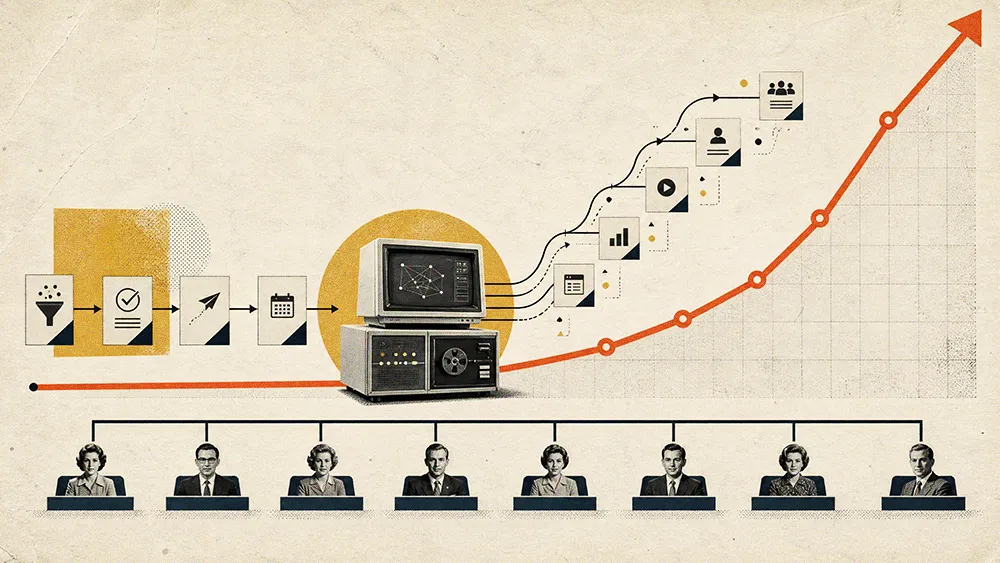
For two decades, the SaaS growth model ran on a fixed relationship between revenue and people. More pipeline meant more Sales Development Reps to work it. More qualified deals meant more Account Executives to carry them. More technical evaluations meant more Sales Engineers in more rooms. Growth was, underneath the dashboards, a hiring plan. Forecast next year's number and then forecast the headcount it would take to hit, because capacity lived in bodies and bodies came from recruiting. The org chart was the growth engine, and it scaled the way recruiting scales, which is to say slowly, expensively, and with a ramp on the far end of every offer letter.
When capacity stops meaning people
When qualifying, demoing, answering the technical question, and onboarding all run on a system instead of a seat, capacity stops being a function of how many people you can hire and ramp and becomes a function of how much compute you can point at demand. The ceiling moves off the org chart and onto the model, and the two variables the old playbook welded together, revenue and headcount, come apart.
The ICONIQ report shows this. Its own framing is that AI adoption is no longer the story, and that the gap between deep adopters and everyone else now shows up in the numbers. The number where it shows up hardest is headcount. In the $25 million to $100 million revenue band, the orgs with AI fully embedded run about 45 go-to-market people where the ones without run 65, close to a third fewer producing the same revenue, and the same gap holds at every band the survey covers, from 20 against 35 at the smallest to 275 against 350 near half a billion in revenue. The eight-point quota gap looks small because quota per rep is the wrong denominator. The thing that changed isn't the unit cost of a deal, it's that adding the next increment of pipeline no longer requires adding the next body to work it.
For a Chief Financial Officer that is a different shape of cost entirely. Headcount is a step function, hired ahead of demand, ramped over quarters, sticky on the way down. Compute is a variable line that tracks usage. A revenue org whose capacity scales with compute can meet a surge without opening a hiring req and can absorb a soft quarter without a reduction in force, because the slow, expensive, human part of the equation is no longer the thing gating growth. The efficiency gains are real. They're the visible edge of the structural change, not the change itself.
Placing the bets
This is the bet a handful of companies are building the entire product around. Amanda Kahlow, the 6sense founder now running the autonomous-sales company 1mind, told TechCrunch, "I'm not playing in outbound," selling six-figure systems that handle inbound buyers from first touch through the close. The pitch isn't a cheaper sales team, but capacity that scales with the demand instead of the payroll, with the people it frees moved onto the relationships and the judgment calls that were never the bottleneck to begin with.
The old model was at least honest about its constraint. To grow revenue you grew the team, and every point of growth carried the cost, the ramp, and the risk of one more hire. Autonomy severs that link. The question a growth plan starts from is no longer how many people next year's number will take, but how little of it a person needs to touch at all.





Read what the room is reading.
New pieces for growth leaders, delivered as they publish. Unsubscribe whenever.